Choosing the best Aluminium Entry Door involves more than comparing colors, prices, and glass patterns. The right door must protect the entrance, control heat transfer, resist weather, and operate smoothly for years. A slim frame may look elegant, yet it can perform poorly without a thermal break. A strong lock may improve security, but weak hinges or poor installation can reduce its value.
Building-science expert Dr. Joseph Lstiburek often reminds professionals, “A building is a system.” That principle matters at the entrance. The door, frame, threshold, seals, wall, and drainage path must work together. When one detail fails, water may collect beneath the sill. Cold air may enter around the frame. The problem is rarely obvious on the showroom floor.
Look closely at practical evidence. Check the door’s thermal performance, air leakage rating, water resistance, hardware quality, and finish warranty. Coastal homes may need enhanced corrosion protection. Busy family entrances need durable hinges and replaceable weather seals. Measure the opening carefully. Installation errors can defeat excellent engineering.
There is no perfect door.
Even premium products require maintenance. Wipe away grit, inspect seals, and keep drainage channels clear. Also, do not trust impressive marketing language alone. Ask for tested performance data and installation guidance. A thoughtful choice balances appearance, climate, budget, security, and long-term care. Sometimes the most attractive option is not the wisest one. That is worth reconsidering before ordering.
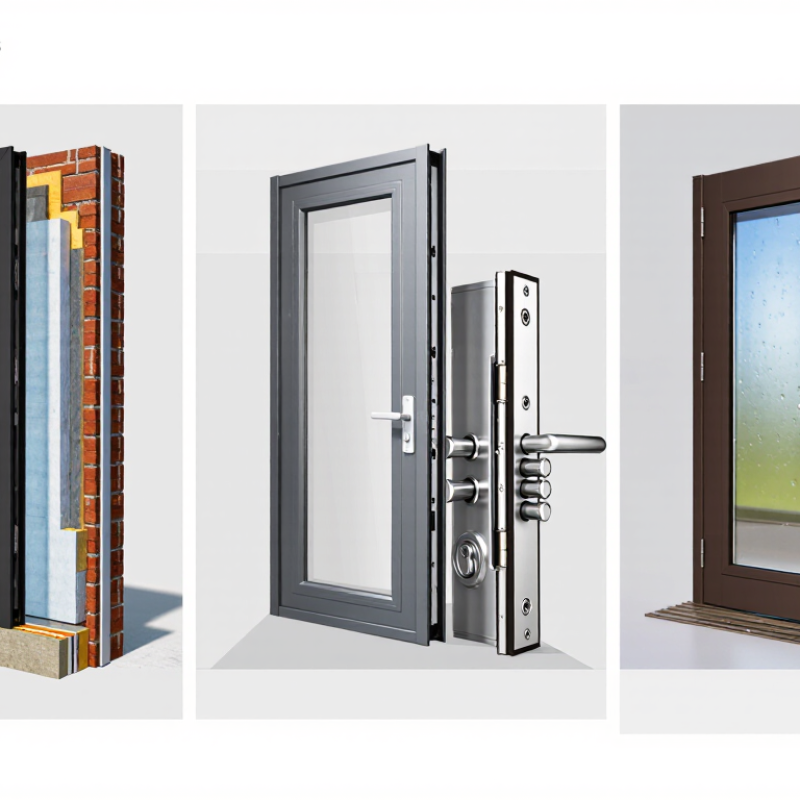
Before choosing an aluminium entry door, define the conditions it must handle. Measure the opening, wall thickness, threshold height, and swing direction. Note the entrance’s exposure to rain, wind, and direct afternoon sun. A coastal doorway needs stronger corrosion resistance than a sheltered interior entrance. Small details matter.
The International Energy Agency’s Buildings 2023 report states that buildings consume about 30% of global final energy. Your door is only one component, but weak sealing can waste comfort and energy. The U.S. Department of Energy estimates that windows, doors, and skylights can represent 25–30% of residential heating and cooling energy use. Ask for the door’s U-factor, solar heat gain coefficient, air-leakage rating, and water-resistance performance. Lower U-factor usually means better insulation. However, an excellent panel cannot correct a badly installed frame.
Security requirements should be specific, not vague. Confirm hinge protection, cylinder quality, multi-point locking, laminated glazing, and tested impact performance where needed. Check the manufacturer’s published test evidence, not only attractive photographs. I have seen homeowners focus on a slim frame and overlook the threshold seal. That mistake becomes obvious during heavy rain. Think carefully about daily use, too: children, luggage, muddy shoes, and repeated opening cycles may demand a more durable finish. A dark coating can also become very hot in direct sunlight. Reconsider the design if maintenance access is difficult.
Define your requirements by prioritizing thermal efficiency, security, weather resistance, durability, maintenance, and design. The chart below uses a practical planning-weight model to help compare the importance of each requirement before selecting a door system.
Selection tip: Give the greatest attention to thermal performance and security, then confirm weather sealing, corrosion resistance, hardware durability, maintenance needs, and appearance for your climate and entry conditions.
Aluminium alloy, profile design, and construction quality determine an entry door’s performance. Common 6063-T5 or 6063-T6 profiles provide good strength and clean machining. Aluminium resists rot, insects, and coastal moisture better than many timber products. However, exposed metal conducts heat quickly. A thermal break is essential for comfort.
The International Aluminium Institute’s 2024 Aluminium Sustainability Report states that recycled aluminium requires about 5% of the energy used for primary aluminium production. Ask for verified recycled content, not vague environmental claims.
Profile depth matters.
A deeper, multi-chamber profile can improve stiffness and reduce heat transfer. Look for continuous polyamide thermal barriers, tight EPDM gaskets, reinforced hinge zones, and mechanically secure corner joints. Poor assembly can undermine an excellent profile. It happens more often than buyers expect.
The U.S. Department of Energy’s Energy Saver guidance estimates that windows account for roughly 25–30% of residential heating and cooling energy use.
Entry doors are smaller, but their seals and frame still affect the building envelope. Check the NFRC-rated U-factor, air leakage, and visible transmittance where available; lower U-factor generally indicates better insulation.
Construction details deserve a close inspection. A multi-point lock can compress seals more evenly, while a weak threshold may admit wind-driven rain.
Request test evidence for air, water, and structural performance under recognized fenestration standards. I would also inspect a showroom corner joint by hand. It should feel rigid, not merely heavy. One limitation remains: laboratory results cannot fully predict installation quality. A skilled installer and a properly drained sill are equally important.
Choosing an aluminium entry door requires more than admiring its finish. Thermal performance deserves careful attention. The U.S. Department of Energy reports that windows can cause 25–30% of residential heating and cooling energy use. Glazed entrance doors can contribute to similar losses. Check the NFRC-rated U-factor and look for a thermally broken aluminium frame. Insulated cores and low-emissivity glass also reduce cold drafts near the threshold. Lower U-factor usually means better insulation.
Security depends on the complete door assembly, not aluminium alone. EN 1627 classifies doors by resistance classes, while testing considers locks, hinges, glazing, and forced-entry tools. A multi-point lock, reinforced strike area, and laminated glass can improve practical protection. The weakest part matters most. A strong panel cannot compensate for a flexible frame or poorly fixed hinges. Ask for test documentation, not vague phrases such as “high security.”
Weather resistance should be verified through recognized testing. FGIA/AAMA 101 standards evaluate air leakage, water penetration, and structural performance under pressure. Look for published results, including the water-test pressure and operating type. A low sill, missing drainage path, or careless installation can cause trouble during wind-driven rain. I have seen excellent doors fail because the threshold was not sealed correctly. That is an uncomfortable reminder: product data matters, but installation quality often decides real-world performance. Recheck the wall opening, flashing, sealant, and threshold before ordering.
Choose an aluminium entry door by matching its style to your home’s architecture and daily routine. Slim frames suit modern façades, while wider profiles create a stronger, more traditional appearance. Check the opening direction, threshold height, and available porch space before ordering. A beautiful door can still feel awkward if it blocks a walkway.
Glazing changes both comfort and character. Low-E double glazing can reduce heat loss, while laminated glass offers better resistance to impact and noise. Clear glass brings daylight, but textured or frosted glass protects privacy near busy paths. Ask for tested U-values and drainage details, not vague energy claims. Hardware deserves equal attention. A multipoint lock, adjustable hinges, and a solid lever should operate smoothly without force. I once underestimated handle height; small children found it difficult to reach. That detail mattered more than expected.
Tips: Request finish samples outdoors, because sunlight alters colour. Powder-coated surfaces are durable, but coastal air still needs regular cleaning. Dark finishes may absorb more heat and show scratches quickly. Choose a threshold that balances weather sealing with easy access. Perfect coordination is unlikely; review the details twice before approving the final measurements.
| Selection Category | Common Options | Best Application | Key Benefits | Important Considerations | Practical Specification Guide |
|---|---|---|---|---|---|
| Door Style | Single hinged door | Most standard residential entrances and compact porches | Simple operation, efficient use of wall space, and generally straightforward installation | Requires a clear opening for the door swing; the handing should be confirmed before manufacture | Typical clear opening: approximately 800–1000 mm wide, subject to local building requirements and accessibility needs |
| Door Style | Double hinged door | Wide entrances, traditional façades, and homes needing a larger access area | Creates a broad opening and can provide a balanced architectural appearance | Needs more wall and floor space; the inactive leaf should have reliable flush bolts or an equivalent locking arrangement | Useful where the entrance width is substantially greater than a standard single-leaf door |
| Door Style | Pivot door | Large contemporary entrances and statement façades | Supports wide, tall door panels with a modern appearance | Pivot hardware must be correctly sized for the door weight; weather sealing and installation tolerances are especially important | Confirm maximum panel dimensions, operating clearance, threshold design, and structural support before ordering |
| Door Style | Sliding entry door | Entrances opening onto patios, gardens, or areas with limited swing space | Does not require an interior or exterior swing zone and can provide a wide glazed opening | Track cleanliness, drainage, panel weight, and resistance to air and water infiltration should be evaluated | Choose a thermally broken sliding system where energy performance is important |
| Frame Construction | Thermally broken aluminium frame | Cold, mixed, and warm climates where indoor comfort and energy efficiency matter | Uses an insulating separator between inner and outer aluminium sections to reduce heat transfer and condensation risk | Performance depends on the complete door assembly, including glass, seals, threshold, and installation | Request the whole-door U-value rather than relying only on the frame or glass value |
| Frame Construction | Non-thermally broken frame | Unconditioned buildings, internal applications, or mild climates with limited thermal requirements | Lightweight, durable, and often more economical | Can conduct heat more readily and may be more susceptible to interior condensation in cold conditions | Use only where local climate, building regulations, and comfort expectations make it suitable |
| Glazing | Clear double glazing | General residential entrances requiring daylight and improved insulation | Balances visible light, thermal performance, and cost | Privacy may be limited; safety glass is normally required in doors and near door openings | Common insulating glass configuration: two panes separated by a sealed spacer, with the cavity filled with air or inert gas |
| Glazing | Low-emissivity double glazing | Energy-conscious homes in heating or mixed climates | Low-e coating reduces radiant heat transfer and can improve insulation compared with ordinary clear glass | Solar-control properties vary; select the coating according to orientation and climate | Compare centre-of-glass U-value, solar heat gain coefficient, visible transmittance, and whole-door performance |
| Glazing | Laminated safety glass | Entrances requiring additional safety, security, acoustic control, or UV reduction | Retains fragments together after breakage and can reduce transmitted noise depending on the interlayer | Heavier than standard monolithic glass; the frame and hinges must be suitable for the increased weight | Specify safety glazing in accordance with applicable local regulations and impact-risk locations |
| Glazing | Obscure, frosted, or patterned glass | Front doors where privacy is needed without eliminating natural light | Reduces direct visibility while maintaining a brighter entrance area | Different patterns provide different levels of privacy and may affect cleaning requirements | Request a physical sample or visual privacy rating before approval |
| Glazing | Triple glazing | Very cold climates or highly energy-efficient building envelopes | Can provide lower glazing heat loss and improved interior comfort | Increases weight, thickness, and cost; hinges, hardware, and frame capacity must be verified | Use when the added performance is justified by climate, energy targets, and the rest of the building envelope |
| Security Hardware | Multi-point locking system | Main residential entrances requiring enhanced resistance to forced entry and improved sealing | Locks the door at several points along the frame and can help maintain consistent compression of seals | Must be correctly aligned; poor installation can cause stiff operation or premature wear | Consider a lock cylinder with anti-pick, anti-drill, and anti-snap protection where relevant to local security risks |
| Security Hardware | Deadbolt or single-point lock | Low-risk applications, secondary entrances, or simpler door designs | Familiar operation and lower hardware complexity | May provide fewer locking points and less compression than a well-designed multi-point system | Confirm compatibility with the door profile, strike plate, cylinder, and local security requirements |
| Hinges | Adjustable heavy-duty hinges | Large or glazed aluminium doors and entrances with frequent use | Allows accurate alignment and supports stable long-term operation | Hinge quantity and load rating must match the finished door weight and dimensions | Check adjustment range, corrosion resistance, and the manufacturer’s maximum sash weight |
| Threshold | Standard weathered threshold | Exterior entrances where weather resistance is a priority | Provides a more effective barrier against wind-driven rain and drafts | May create a small step; drainage paths must remain clear | Review threshold height, water drainage, seal compression, and compatibility with the finished floor |
| Threshold | Low or flush threshold | Accessible entrances and locations requiring easier wheeled or foot traffic | Reduces the trip edge and improves ease of access | Weather performance may require additional drainage, a protected entrance, or a carefully designed sill | Balance accessibility with local water-management and weather-resistance requirements |
| Hardware Finish | Stainless steel or brushed metal appearance | Contemporary façades and high-use entrances | Neutral appearance, easy coordination with modern fittings, and good visual durability | Actual corrosion resistance depends on the material grade, surface treatment, and exposure conditions | For coastal or highly corrosive locations, confirm the hardware grade and maintenance recommendations |
| Hardware Finish | Powder-coated hardware | Projects requiring coordinated colours across handles, frames, and accessories | Offers a wide range of colours and a consistent finish when properly applied | Edges, moving parts, and areas exposed to abrasion require careful use and maintenance | Confirm colour consistency, coating suitability for exterior use, and replacement availability |
| Frame Finish | Standard powder coating | Most residential and commercial exterior applications | Provides a durable coloured surface with relatively low routine maintenance | Surface preparation and coating quality strongly affect long-term appearance and corrosion resistance | Choose an exterior-grade coating and follow the cleaning guidance for the selected finish |
| Frame Finish | Anodised aluminium | Projects seeking a metallic appearance and a hard, integral surface treatment | Maintains the visible character of aluminium and offers good resistance to normal wear | Colour range is generally more limited than powder coating; batch and orientation differences can occur | Request a physical sample, especially when matching adjacent aluminium products |
| Frame Finish | Textured or matte finish | Modern homes and entrances where reduced glare and a contemporary appearance are desired | Can disguise minor marks and fingerprints better than some high-gloss surfaces | Textured surfaces still require regular cleaning, particularly in polluted or coastal environments | Specify the colour, gloss level, texture, and exterior durability class where applicable |
| Weather Performance | Compression seals and drainage channels | All exterior aluminium entry doors | Help reduce drafts, water penetration, and dust when correctly designed and installed | Seals can deteriorate from ultraviolet exposure, dirt, or incorrect adjustment | Inspect seals periodically and keep drainage openings free from dirt and debris |
| Energy Performance | Whole-door thermal rating | Heated or cooled buildings where energy use and comfort are important | Provides a more meaningful comparison because it includes the frame, glass, edge effects, and door configuration | Ratings cannot be compared accurately unless the test methods and dimensions are equivalent | Ask for documented U-value results for the complete door assembly and the intended glazing option |
| Maintenance | Routine cleaning and adjustment | Every aluminium entry door, especially those near roads or the coast | Helps preserve finish quality, seal performance, drainage, and smooth hardware operation | Abrasive cleaners, harsh solvents, and neglected drainage can damage surfaces or shorten service life | Clean with mild soapy water and a soft cloth; inspect fasteners, seals, hinges, locks, and drainage at least annually |
Choosing the best aluminium entry door starts with installation standards, not appearance. Confirm the door’s U-factor and air-leakage results through NFRC and ASTM E283 testing. Local building codes may also require specific sill heights, safety glazing, drainage, and wind-load ratings. A qualified installer should use a sill pan, compatible flashing, level shims, and low-expansion foam. Small gaps around the frame can become cold, damp lines in winter.
The U.S. Department of Energy reports that air leakage can represent 25–40% of a home’s heating and cooling energy use. This makes installation quality financially important. Thermal breaks inside aluminium frames can reduce heat transfer, but they do not fix a badly fitted door. Maintenance is usually simple: clean tracks and drainage paths, inspect weather seals, lubricate hardware, and check fasteners annually. Coastal homes need more frequent rinsing because salt deposits can damage finishes. I used to focus too heavily on frame strength. Moisture control is often the quieter problem.
Tips: Request the complete installation scope in writing. Compare the threshold, seal replacement, hardware adjustment, and disposal costs. NIST Handbook 135 defines life-cycle cost as purchase, operation, maintenance, repair, and replacement expenses. A cheaper door may cost more after repeated adjustments. Ask for tested performance data, warranty exclusions, and an estimated maintenance schedule. Leave room for uncertainty; installation conditions can change the final price.
Choose slim frames for modern façades and wider profiles for a traditional appearance. Check the opening direction and porch space. A beautiful door can still block a walkway.
Confirm the opening direction, threshold height, available porch space, and walking routes. Measure twice. Small errors can affect daily comfort.
Low-E double glazing can reduce heat loss. Laminated glass may improve impact resistance and noise control. Frosted or textured glass protects privacy near busy paths.
Ask for tested U-values, air-leakage results, drainage details, and wind-load ratings. Avoid vague energy promises. Numbers are more useful.
Look for a multipoint lock, adjustable hinges, and a solid lever. Test every movement. Hardware should work smoothly without force.
Check the handle height and threshold design. A handle placed too high may frustrate children. Easy access sometimes matters more than appearance.
The installer should use a sill pan, compatible flashing, level shims, and low-expansion foam. Small frame gaps can create cold, damp lines.
Clean tracks and drainage paths regularly. Inspect weather seals, lubricate hardware, and check fasteners annually. Coastal homes need more frequent rinsing.
Request finish samples outdoors because sunlight changes colour. Dark finishes can absorb more heat and show scratches quickly. Coastal salt also needs attention.
Include purchase, installation, operation, maintenance, repairs, and replacement. Request warranty exclusions and a maintenance schedule. The cheaper option may cost more later.
Choosing the right Aluminium Entry Door starts with understanding your home’s needs, including the entrance size, local climate, traffic frequency, security expectations, and available budget. Compare door materials, aluminium grades, profile designs, frame depth, and construction quality to ensure the door offers strength, stability, and long-term value. Pay close attention to thermal insulation, weather seals, drainage, resistance to wind and moisture, and reliable locking systems.
Next, select a style that complements your property, along with suitable glazing, handles, hinges, colors, and surface finishes. Energy-efficient glass and carefully designed profiles can improve comfort while reducing heat transfer. Before purchasing, confirm that installation follows recognized building standards and that the installer can provide accurate measurements and proper sealing. Finally, consider cleaning requirements, hardware care, repair accessibility, warranty coverage, and the total cost over the door’s lifespan. A balanced evaluation will help you choose an attractive, secure, durable, and practical entrance solution.

ArmorSafe Doors