A Luxury Aluminum Entry Door is more than a polished entrance. It must balance security, weather resistance, thermal performance, and visual impact. The U.S. Department of Energy notes that heat gain and loss through windows account for about 25–30% of residential heating and cooling energy use. That figure concerns windows, not entry doors alone, but it highlights why the whole building envelope deserves attention. The 2024 Global Status Report for Buildings and Construction also places buildings and construction at roughly 32% of global energy demand. These figures make material choice and installation quality more than cosmetic decisions.
For a useful starting point, this guide compares ten Chinese manufacturers by product range, customization, documented performance, and export experience. Architect Ludwig Mies van der Rohe’s widely cited maxim, “God is in the details,” fits the subject well. On an entry door, those details are tangible: a tight frame joint, a smooth lock action, and a finish that holds up beside daily use. Still, rankings are imperfect. A striking catalog image cannot prove long-term durability, and specifications may vary by model or project. Buyers should verify test documentation, warranty terms, hardware options, and installation support directly with each manufacturer. The companies listed here offer different strengths, not a universal best choice.
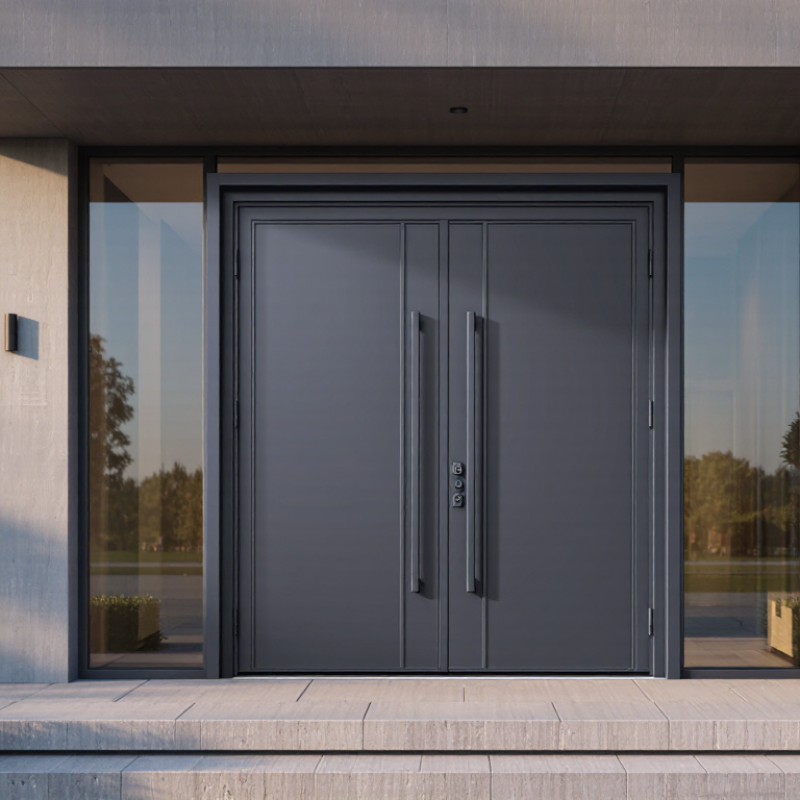
Luxury Aluminum Entry Doors: Materials, Design, and Key Performance Factors
Luxury aluminum entry doors combine narrow sightlines with strong, corrosion-resistant frames. Their appearance depends on more than a dark powder-coated finish. Alloy quality, coating preparation, and drainage details influence how well the door handles daily exposure. At the threshold, standing water and grit can wear finishes sooner than expected.
Thermal performance needs careful checking. Aluminum transfers heat readily, so a well-designed thermal break helps separate the interior and exterior frame surfaces. Compare whole-door U-factor and air-leakage ratings, rather than judging insulation by frame thickness alone. The National Fenestration Rating Council identifies U-factor as a measure of heat transfer; lower values indicate better insulation. Still, trade-offs remain. Large glazed panels can bring daylight, but their glass specification affects heat gain and privacy.
Durability also involves material sourcing and repair. The International Aluminium Institute reports that recycling aluminum can save up to 95% of the energy used for primary production. That figure supports recycled content as a useful specification, though it does not prove a finished door will perform well. Details matter. Ask for tested air, water, and structural performance under the applicable fenestration standard, then inspect seals, hinges, and corner joints. A beautiful handle cannot compensate for a poorly fitted threshold.
Architectural Alloy Benchmark: 6063 Aluminum at 2.70 g/cm³
China Top 10 Luxury Aluminum Entry Door Manufacturers
Architectural Alloy Benchmark: 6063 Aluminum at 2.70 g/cm³
6063 aluminum is a common architectural extrusion alloy, with a density of about 2.70 g/cm³. This figure offers a useful material baseline, but it cannot measure a door’s overall quality. A lighter frame may be easier to handle, while profile depth, wall thickness, reinforcement, and hardware affect stiffness and everyday performance. Details matter.
For a luxury entry door, look beyond the visible finish. Deep stiles, neatly joined corners, and well-supported hinges help control sagging on heavy panels. Thermal breaks can reduce heat transfer, but they do not make the whole doorway airtight. Gaskets, thresholds, installation, glazing, and drainage matter too. Alloy temper and coating quality also influence performance. One caveat: specifications can look precise while leaving assembly details unclear.
Tips: Ask for the alloy and temper, profile-wall dimensions, finish system, and tested performance data. Compare complete door assemblies, not just sample swatches or headline numbers. Check corner joints and seals in person when possible. Even a small threshold gap can become noticeable on a windy, rainy day.
How to Evaluate China’s Top 10 Manufacturers: Five Buyer Criteria
When comparing China’s top 10 luxury aluminum entry door manufacturers, look beyond showroom photos.
Ask how the frame is engineered, which aluminum profiles are used, and how corner joints are assembled. Check the corners. A clean weld or tight mechanical joint matters more than a glossy finish. Request drawings that show frame depth, thermal breaks, and hardware locations.
Customization is useful only when measurements stay precise.
Share your opening dimensions, wall type, and preferred swing direction, then review a shop drawing before production. Ask for evidence. Sample doors, finish samples, and inspection records can help verify what a supplier actually delivers. Also ask how surface finishes are tested for fading, scratches, and moisture exposure. A sample may look excellent indoors but reveal little about long-term performance.
Delivery and after-sales support deserve equal attention.
Confirm packaging details, production milestones, replacement-part availability, and who handles installation questions. Ask for recent project references with comparable door sizes and climates. Then check whether the details match your needs. One imperfect point: online specifications may be incomplete or translated loosely, so clarify unclear terms in writing. A responsive sales contact is helpful, but consistent technical answers matter more. Be cautious when a quote lists premium features without naming materials, dimensions, or test methods.
Comparing Door Performance: Thermal, Air, Water, and Wind-Load Ratings
For a luxury aluminum entry door, appearance is only part of the comparison. Thermal performance is often reported as a U-factor; a lower value generally indicates less heat transfer under the stated test conditions. Check the complete door assembly, not just the glass. A slim frame, insulated thermal break, and well-sealed threshold can all affect comfort near the entry.
Air leakage ratings show how much air passes through a tested assembly at a specified pressure. Compare figures only when the test method and units match. Small gaps matter. Water-penetration results describe performance under controlled spray and pressure, but they do not promise that every installation will stay dry. Look closely at sill drainage, corner joints, and weather seals. After heavy rain, these are the details a homeowner may notice first.
Wind-load ratings indicate resistance to pressure and deflection, and should suit the building’s exposure and opening size. A coastal site or tall, exposed façade may need different performance than a sheltered entrance. Ask for test documentation covering the actual door configuration, including its size, glazing, hardware, and frame. I would not compare a single headline number across manufacturers without checking those details. Installation still complicates the picture: even a well-tested door can underperform if the frame is out of square or the perimeter seal is incomplete.
One part is easy to overlook: the installer’s method.
Manufacturer Profiles: Product Range, Certifications, Customization, and Export Reach
When comparing China’s leading luxury aluminum entry-door manufacturers, look beyond finish samples. Strong profiles specify thermal-break construction, frame depth, glazing options, hardware grades, and available opening styles. They also distinguish factory management certificates from product test reports. Ask for current ISO 9001 or ISO 14001 documentation where relevant, plus evidence of air, water, and structural testing. Paperwork matters.
Customization should be measurable, not merely “bespoke.” A useful quotation lists clear opening dimensions, panel thickness, surface treatment, glass build-up, threshold design, and hardware placement. Request a full-size corner sample or a detailed shop drawing before production. Small gaps around a threshold can undermine an otherwise impressive entrance. One overlooked detail: dark finishes may show dust and scratches more readily.
Export capability means more than shipping experience. Check packing methods, installation guidance, spare-part availability, lead times, and whether documentation matches the destination market. The 2023 Global Status Report for Buildings and Construction, published by UNEP and GlobalABC, reports that buildings used about 34% of global energy and produced 37% of energy- and process-related carbon emissions in 2022. That context makes thermal performance worth checking, though a door alone cannot deliver building-wide savings. Ask manufacturers for tested values, not broad efficiency claims. A glossy catalogue is not proof.
Conclusion
This guide explores the key features that define a Luxury Aluminum Entry Door, from material selection and architectural design to durability and everyday performance. It explains why 6063 aluminum, with a density of 2.70 g/cm³, is commonly considered for door systems, and outlines how buyers can assess manufacturers using five practical criteria, including product quality, technical capabilities, customization options, certifications, and export experience.
The article also compares essential performance factors such as thermal insulation, air permeability, water resistance, and wind-load capacity, helping readers understand which specifications matter for different projects. Manufacturer profiles focus on product ranges, available configurations, verification credentials, and international reach, offering a structured way to compare suppliers and identify a solution suited to a building’s design, climate, and performance needs.

 ArmorSafe Doors